
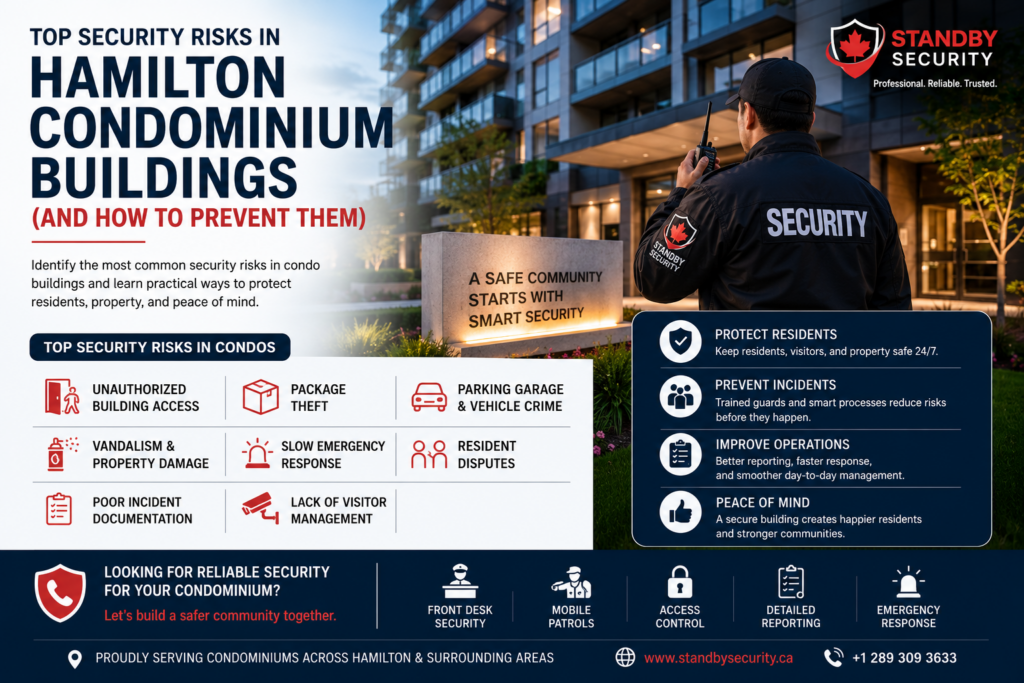
Ask any experienced property manager what keeps them awake at night, and the answer usually isn’t landscaping, snow removal, or routine maintenance.
It’s security.
One unexpected incident can quickly become a costly problem—not only financially, but also for the building’s reputation. Residents begin questioning management decisions, condo boards receive complaints, insurance companies request documentation, and what started as a small security issue suddenly becomes everyone’s problem.
This is exactly why professional Building Security Services in Hamilton have become a priority for many condominium corporations and property management companies.
Security today isn’t simply about having cameras installed or doors that require access cards. It’s about creating a building where residents feel safe, visitors are properly managed, and problems are prevented before they escalate.
As Hamilton continues to grow with new condominium developments in Downtown Hamilton, Ancaster, Stoney Creek, Dundas, Waterdown, and surrounding communities, residential buildings are becoming busier than ever. More residents mean more visitors, more deliveries, more contractors, and ultimately, more opportunities for security gaps.
The good news is that most of these risks are preventable with the right security strategy.
If you’re evaluating security options for your property, our Condominium Security Services explain how professional on-site security helps protect residents while supporting property managers.
For apartment buildings and residential communities, you can also explore our Residential Security Services.
A Typical Morning at a Hamilton Condominium
Imagine it’s 8:15 on a weekday morning.
Residents are leaving for work.
A moving company has arrived.
Three delivery drivers are waiting in the lobby.
A contractor needs access to the mechanical room.
Two visitors are waiting for residents.
Meanwhile, someone quietly follows another resident through the front entrance without using the access system.
Nobody notices.
Nothing happens immediately.
Later that evening, a resident reports that two bicycles have disappeared from the underground parking garage.
Was the theft connected to the person who entered earlier?
Nobody knows.
Unfortunately, situations like this happen far more often than many people realize.
Most security incidents don’t begin with dramatic events.
They begin with small operational gaps.
One unsecured entrance.
One visitor who wasn’t verified.
One delivery left unattended.
One contractor who entered without checking in.
Over time, these small issues create larger security risks.
Why Condo Security Has Changed
Condominium living has evolved dramatically over the past decade.
Years ago, buildings experienced predictable daily activity.
Today, residential communities function almost like small businesses.
Every day brings:
- Online shopping deliveries
- Food delivery drivers
- Contractors
- Cleaning companies
- Maintenance crews
- Realtors showing units
- Moving companies
- Guests
- Ride-share drivers
For a building with 250 residents, this can easily mean hundreds of people entering and leaving every single day.
Technology certainly helps.
Access cards.
Video intercoms.
CCTV systems.
Smart locks.
Mobile access.
All of these are valuable tools.
But technology only records what happens.
Professional security helps prevent incidents before they occur.
That’s one of the biggest differences property managers notice after implementing professional building security.
The Hidden Cost of Poor Security
When people think about security, they usually think about crime.
In reality, property managers spend far more time dealing with the consequences of smaller incidents.
For example:
A missing package.
A damaged elevator.
Graffiti in a parking garage.
Residents arguing over unauthorized parking.
Visitors entering without permission.
Contractors accessing restricted areas.
Each issue requires:
- Staff time
- Investigation
- Emails
- Incident reports
- Resident communication
- Follow-up meetings
Those costs add up quickly.
Professional security doesn’t just reduce crime.
It reduces operational disruption.
That means property managers spend less time solving avoidable problems and more time improving their communities.
Security Risk #1 – Unauthorized Building Access
This remains one of the biggest challenges facing condominium buildings throughout Hamilton.
Most unauthorized visitors don’t break into buildings.
They simply walk in.
Sometimes they follow another resident through the main entrance.
Sometimes a delivery driver props open a door.
Sometimes contractors forget to secure an entrance after finishing work.
This is known as tailgating, and it’s one of the most common security vulnerabilities in residential buildings.
Why It’s a Problem
Once someone enters a building unnoticed, they may gain access to:
- Underground parking
- Storage lockers
- Fitness facilities
- Mail rooms
- Residential floors
- Mechanical areas
Even if no crime occurs, unauthorized access creates unnecessary risk for residents.
What We Recommend
Buildings with the strongest security usually combine technology with trained personnel.
That includes:
- Visitor verification
- Access control
- Lobby monitoring
- Contractor registration
- Delivery management
- Regular patrols
Security isn’t about stopping everyone from entering.
It’s about knowing who is inside your building and why they’re there.
Security Risk #2 – Package Theft
Ten years ago, package theft wasn’t one of the biggest concerns for condominium managers.
Today, it’s one of the most common resident complaints.
With online shopping becoming part of everyday life, residential lobbies receive deliveries almost constantly.
Many buildings receive:
- Amazon
- FedEx
- UPS
- Canada Post
- Grocery deliveries
- Furniture deliveries
- Meal delivery services
When packages are left unattended, they become easy targets.
A Realistic Example
A Hamilton condominium receives more than 100 deliveries every weekday.
During busy periods, couriers simply leave packages inside the lobby because nobody is available to receive them.
Residents returning home later discover missing deliveries.
Management investigates.
Security footage is reviewed.
Emails are exchanged.
Insurance questions arise.
All because packages were left unsecured.
Professional security helps eliminate many of these issues by:
- Receiving deliveries
- Monitoring lobby activity
- Recording courier access
- Contacting residents
- Reporting suspicious behaviour
It’s a simple operational improvement that creates a much better resident experience.
Security Risk #3 – Underground Parking and Vehicle Crime
Parking garages are often the least monitored areas of residential buildings.
Unfortunately, they’re also one of the most attractive locations for theft and vandalism.
Property managers commonly report:
- Vehicle break-ins
- Bicycle theft
- Damaged vehicles
- Unauthorized parking
- Loitering
- Storage locker theft
Because these areas are quieter and receive less foot traffic, incidents often go unnoticed until much later.
What Works Best?
Professional security teams don’t simply patrol on a schedule.
They vary patrol times, monitor unusual activity, inspect access points, and pay attention to patterns that cameras alone may not identify.
Many incidents are prevented simply because a visible security presence discourages opportunistic crime before it happens.
What We Commonly See in Hamilton
Although every condominium is different, many of the buildings we work with experience similar operational challenges.
The most common include:
- Visitors entering behind residents without checking in.
- Delivery drivers leaving packages unattended in the lobby.
- Contractors accessing service areas without proper registration.
- Parking garages being used by unauthorized vehicles.
- Residents reporting suspicious activity after business hours.
- Condo boards receiving repeated complaints about the same security concerns.
Interestingly, these issues are rarely caused by a lack of technology.
More often, they happen because no one is actively monitoring daily building activity.
Technology can alert you after something happens.
Professional security helps prevent it from happening in the first place.
Security Risk #4 – Slow Emergency Response
Emergencies rarely happen when it’s convenient.
They can occur late at night, during weekends, or even when building management isn’t on-site.
Some of the most common emergencies in condominium buildings include:
- Fire alarms
- Medical emergencies
- Water leaks
- Elevator entrapments
- Power outages
- Gas odours
- Suspicious individuals
- Domestic disturbances
When these situations occur, every minute matters.
One of the biggest misconceptions is that calling 911 is enough.
Emergency services may still take several minutes to arrive depending on traffic, weather, or the nature of the emergency.
During those critical first moments, trained security personnel become the first line of response.
A Practical Example
Imagine a resident suffers a medical emergency in the lobby.
Without on-site security:
- Other residents try to help.
- Someone searches for building management.
- Emergency services are called.
- Confusion delays assistance.
With a trained security officer present:
- Emergency services are contacted immediately.
- The area is secured.
- Building access is cleared for first responders.
- Elevators are reserved if required.
- Residents are guided safely away from the scene.
Those few minutes can make a significant difference.
Security Risk #5 – Vandalism and Property Damage
Vandalism doesn’t always involve major damage.
Often it’s smaller incidents that slowly increase maintenance costs.
Property managers frequently deal with:
- Graffiti
- Broken entrance doors
- Damaged mailboxes
- Elevator misuse
- Amenity room damage
- Storage locker tampering
Every repair costs money.
More importantly, repeated vandalism sends the wrong message to residents.
People naturally feel less secure when they repeatedly notice damaged property.
Professional security helps reduce these incidents through regular patrols, visible presence, and early intervention.
Security Risk #6 – Resident Disputes
One area that’s often overlooked is conflict between residents.
Noise complaints.
Parking disagreements.
Smoking violations.
Pet-related issues.
Visitor disagreements.
These situations don’t always require police, but they do require someone who can remain calm, communicate professionally, and de-escalate conflict.
Experienced security guards receive training in conflict management and know how to respond professionally while documenting incidents for property management.
That documentation often becomes valuable if the same issue happens again.
Security Risk #7 – Poor Incident Documentation
After speaking with many property managers, one challenge comes up repeatedly.
Important incidents aren’t documented properly.
Perhaps someone reports suspicious activity.
A resident complains about an unauthorized visitor.
A contractor damages common property.
If details aren’t recorded immediately, important information is often forgotten.
Professional security teams maintain detailed records including:
- Daily activity reports
- Visitor logs
- Patrol reports
- Incident reports
- Maintenance observations
- Photographic documentation (when appropriate)
Good documentation protects residents, property managers, and condominium corporations.
It also helps identify recurring problems before they become larger issues.
Three Common Security Mistakes Condo Boards Make
Many condominium boards invest in security.
Unfortunately, some investments don’t actually solve the underlying problems.
Here are three mistakes we commonly see.
Mistake #1 – Relying Only on Cameras
Security cameras are extremely valuable.
But they don’t stop someone from entering a building.
They don’t question suspicious visitors.
They don’t respond to emergencies.
They simply record events.
The strongest security programs combine technology with trained professionals.
Mistake #2 – Assuming Every Building Needs the Same Security Plan
A 40-unit condominium has completely different requirements than a 300-unit residential tower.
Factors such as:
- Building size
- Resident population
- Number of entrances
- Visitor traffic
- Parking garages
- Commercial units
all influence the type of security that’s required.
Professional security should always begin with a property assessment – not a standard package.
Mistake #3 – Waiting Until Something Happens
Many buildings only upgrade security after:
- A theft
- Resident complaints
- Property damage
- Insurance claims
- Negative media attention
By then, the damage has already occurred.
The best security strategy is preventative.
Questions We Often Hear From Property Managers
After working with condominium communities, we’ve noticed many boards ask similar questions.
Do we really need 24-hour security?
Not necessarily.
Some buildings benefit from overnight coverage only.
Others require lobby security during peak hours.
Every property should be assessed individually.
Can security guards perform concierge duties?
Yes.
Many condominium communities choose concierge-style security where trained guards welcome residents, assist visitors, receive deliveries, and monitor building activity.
Learn more about our Concierge Security Services:
Will security reduce insurance costs?
Insurance policies vary.
While security doesn’t automatically lower premiums, reducing theft, vandalism, and liability incidents may positively influence future claims and risk assessments.
Property owners should always discuss coverage with their insurance provider.
How many security guards does a condominium need?
There’s no universal answer.
The number depends on:
- Building size
- Number of entrances
- Operating hours
- Resident population
- Visitor traffic
- Security objectives
Some properties only require one front desk officer.
Others benefit from mobile patrols combined with concierge security.
Why Building Security Is About More Than Crime
Many people think security exists only to stop criminals.
In reality, good security improves everyday operations.
Property managers often notice improvements such as:
- Fewer resident complaints
- Better visitor management
- Faster emergency response
- Improved communication
- More accurate incident reporting
- Greater resident confidence
That’s why professional security is increasingly viewed as part of property management – not simply an additional expense.
Related Resources
If you’re researching condominium security, these guides may also help.
7 Reasons Condo Buildings Need Security Guards
This article explains why more residential communities are investing in full-time security and how it benefits both residents and property managers.
Why Condo Boards Need Professional Security
Learn how professional security supports condominium boards through better access control, emergency preparedness, and long-term risk reduction.
Hamilton Security Services
Explore our complete range of professional security services available throughout Hamilton for residential, commercial, condominium, and property management clients.
How to Choose the Right Security Partner for Your Condominium
Choosing a security company isn’t just about comparing hourly rates. It’s about finding a team that understands how residential communities operate and can work as an extension of your property management team.
Before signing a contract, ask these questions:
Does the company specialize in condominium security?
Residential buildings have different security requirements than construction sites, retail stores, or event venues. Your provider should have experience managing access control, resident interactions, visitor management, and emergency procedures in condominium environments.
Are the security guards licensed and trained?
In Ontario, every security guard must hold a valid licence. Beyond licensing, ask about training in conflict de-escalation, customer service, emergency response, report writing, and condominium operations.
Will the security plan be customized?
Every property is different.
A 60-unit condominium in Dundas won’t have the same security requirements as a 300-unit residential tower in Downtown Hamilton.
A professional provider should begin with a site assessment before recommending coverage.
How are incidents reported?
Detailed reporting helps property managers identify recurring issues and provides valuable documentation for condo boards, insurance providers, and legal matters.
Look for providers that offer:
- Daily activity reports
- Incident reports
- Visitor logs
- Patrol reports
- Immediate escalation procedures
What Makes StandBy Security Different?
At StandBy Security, we understand that condominium security isn’t just about standing in a lobby.
It’s about helping property managers create safer communities while making residents feel comfortable in their own homes.
Our security professionals work closely with condominium boards and property management companies throughout Hamilton to develop practical, property-specific security plans.
Depending on your building’s needs, services may include:
- Front desk security
- Concierge security
- Visitor management
- Access control
- Mobile patrols
- Common area patrols
- Parking garage monitoring
- Emergency response
- Daily reporting
Rather than offering a standard package, we tailor every security plan to the property’s size, traffic, operational requirements, and budget.
Explore our services:
Condominium Security Services
https://standbysecurity.ca/security-services-hamilton/condominium-security-services-hamilton/
Residential Security Services
https://standbysecurity.ca/security-services-hamilton/residential-security-services-hamilton/
Hamilton Security Services
https://standbysecurity.ca/hamilton/
Security Is an Investment – Not Just an Expense
It’s easy to view security as another operating cost.
However, experienced property managers often look at it differently.
The cost of one major incident can easily exceed months of professional security coverage.
Consider the potential impact of:
- Property damage
- Resident injuries
- Insurance claims
- Legal disputes
- Negative online reviews
- Resident turnover
- Lost confidence from condo owners
Preventing even one serious incident can protect both your budget and your building’s reputation.
Professional security isn’t simply there to respond after something happens.
Its real value lies in preventing many incidents from happening in the first place.
Building Stronger Communities Through Better Security
The best condominium communities share something in common.
Residents feel safe.
Visitors know there are clear procedures.
Property managers spend less time dealing with avoidable issues.
Condo boards receive fewer complaints.
Buildings maintain a positive reputation.
Security plays an important role in creating that environment.
It’s not about making residents feel like they’re living in a high-security facility.
It’s about creating a community where safety becomes part of everyday operations.
Frequently Asked Questions
What are the biggest security risks for condominium buildings?
Some of the most common risks include unauthorized access, package theft, parking garage incidents, vandalism, emergency situations, and poor visitor management. A proactive security plan helps reduce these risks before they become costly problems.
Do all condominium buildings need 24/7 security?
Not necessarily.
The right level of security depends on factors such as building size, resident population, visitor traffic, and operational requirements. Some buildings require full-time front desk security, while others benefit from scheduled patrols or concierge security.
How do security guards support property managers?
Professional security guards assist with access control, visitor management, emergency response, incident reporting, patrols, and enforcing building policies. This allows property managers to focus on daily operations while improving resident safety.
What’s the difference between residential security and condominium security?
Residential security often covers apartment buildings, gated communities, and housing developments, while condominium security focuses specifically on the operational needs of condo corporations, boards, residents, and shared amenities.
How often should condominium security procedures be reviewed?
Security procedures should be reviewed at least once a year or whenever there are significant changes to the property, such as renovations, increased occupancy, or new access systems. Regular reviews help ensure the security plan remains effective.
Continue Exploring
If you found this guide helpful, you may also like:
7 Reasons Condo Buildings Need Security Guards
https://standbysecurity.ca/7-reasons-condo-buildings-need-security-hamilton/
Why Condo Boards Need Professional Security
https://standbysecurity.ca/why-condo-boards-need-professional-security-hamilton/
Condominium Security Services
https://standbysecurity.ca/security-services-hamilton/condominium-security-services-hamilton/
Residential Security Services
https://standbysecurity.ca/security-services-hamilton/residential-security-services-hamilton/
Hamilton Security Services
https://standbysecurity.ca/hamilton/
Protect Your Residents with a Security Strategy That Works
Every condominium faces unique challenges, and the right security plan should reflect those needs – not a generic checklist.
If your condo board or property management team is reviewing building security, StandBy Security can help you assess your current setup and recommend practical solutions tailored to your property.
Visit https://standbysecurity.ca/ to learn more about our condominium, residential, and property management security services across Hamilton.
Reviewed by the StandBy Security operations team. Last reviewed: .